




Try the bar’s intended ice in the glass before approving it. The cube should enter easily and leave room for the planned pour below the rim. Capacity alone cannot answer that fit question, and a trial with smaller ice will not represent service. For whisky glasses intended for large cubes, the ice is part of the sample review.
Glass and ice can each meet their own specification yet fail to work together. If the cube catches at the opening after the glass and artwork have been approved, the problem is their fit rather than necessarily a defect in either purchase. Include the actual ice dimensions and sample in the brief before those decisions are closed.
What Does “Large” Mean on Your Order?
Ask the bar team to show you the ice. A description in an email is a starting point, but “large cube” is not a dimension. There may be more than one mould in use, or an outside ice supplier may offer several formats. Decide which one the proposed glass has to accept. If that decision is still open, so is the glass selection.
You’ll want measurements from more than one piece of ice. Include the larger pieces in the batch, and note which mould or supplier they came from. Those notes will matter again when somebody suggests changing the ice order. Without them, a new format may arrive at the bar long after the glass supplier has finished production.
Take a hypothetical 50 mm square cube. The distance between opposite corners of its face is about 71 mm, which is considerably more than the side length. Hold that face level above a round glass and the problem becomes obvious: the corners have to get through as well. The figures here describe the example cube, not a tested match with one of the products shown.
Could you tilt the cube? Perhaps, depending on the glass and the ice. That is something to try gently with a sample. But if each drink starts with somebody turning a cube around to find a way in, it isn’t a particularly convenient match. And if the bar later switches to spheres, you’ll be back at the sample stage: the earlier cube trial hasn’t answered that question.
Check Whisky Glasses for Large Ice Cubes Below the Rim
Watch where the ice comes to rest. It might clear the opening quite happily and then get stuck farther down. Perhaps the sides narrow, or there is less depth above the solid base than you thought. Where has it stopped? If it is wedged against the wall, passing the rim has not resolved the fit.
A drawing marked with outside dimensions can leave you doing quite a bit of guessing. How much of that height is solid glass at the bottom? How much of the rim diameter belongs to the wall? Request an internal measurement or drawing when that space is central to your choice. A guessed figure taken from a photograph is not worth putting into the order.
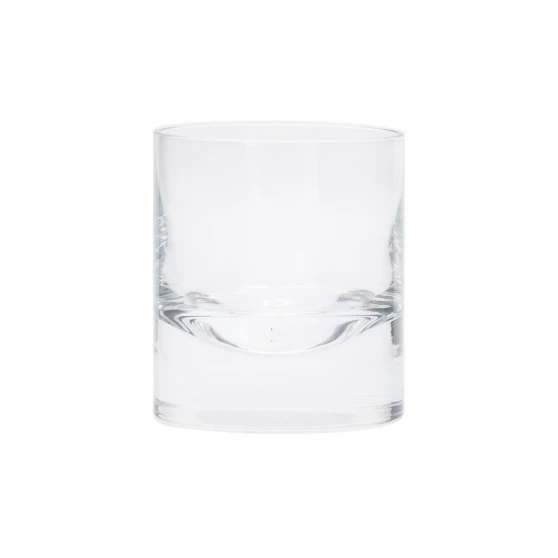
The Heavy Base Whisky Glass is a candidate when you want that substantial-base appearance. It is worth asking for a sample of the exact version on the quotation. There is no ice-clearance measurement in the family name, and you still need to find out how far your cube will sit above that base.
A useful sample note might read “ice passes the opening but rests too high,” rather than “wrong size.” The first tells the supplier what needs attention. A photograph from the side would help explain it, particularly with the ice dimensions written beside it. You can use those same notes when a second sample arrives and see whether the specific problem has been resolved.
Make One Complete Drink Before Approving the Glass
Now make the drink you intend to sell. Before you pour, be clear about the two numbers in front of you: the vessel’s capacity and the recipe’s measure. If the capacity means filled to the brim, you certainly aren’t aiming for that level on a carrying tray. Use the agreed recipe with the ice in place, down to the garnish that will accompany it.
A peel or other garnish can occupy the last bit of space beside a cube. From above, the arrangement may look fine; from the side, it may be crowded near the lip. Carry the glass as you normally would and consider whether the filling level is practical. The approval should cover the finished serve, not just an empty glass containing ice.
As the ice changes during use, check how it moves when the glass is tipped. Is the drink comfortable to sip? Does the ice shift into an awkward position? There is no need to turn this into a claim about every drink or every ice mould. Record what you actually tried, with enough detail for somebody else to repeat it.
For retail buyers of whisky glasses for large ice cubes, this can prevent overpromising on the box. Give customers the verified opening and capacity information, with a realistic serving photograph. “Fits all large ice” would go much further than a trial with one format. Customers may already own moulds of quite different dimensions.
Weight and Decoration Are Separate Decisions
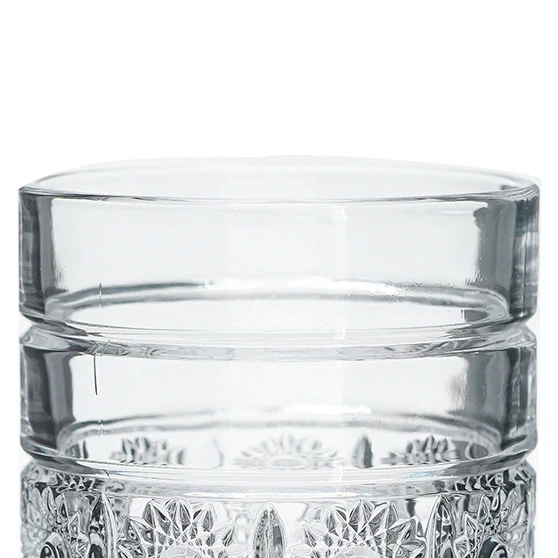
A Machine Pressed Whisky Glass might be closer to the look you have in mind, particularly for a patterned retail collection. Bring the particular version you’re considering into the sample comparison. You can judge the decoration with a drink inside and see how it feels in your hand. If you choose a different shape within the range, though, don’t assume your earlier ice measurements still apply.
There is a difference between holding one empty glass at a desk and carrying several filled ones. Before asking for a heavier or lighter version, give the sample to the service team. What do they make of it? Put their comments beside its measured empty weight. If you later compare a second sample, you can explain exactly which part of the handling you hoped to change, rather than treating weight as a quality score.
Weight tells the buyer how the sample feels in the hand; it does not establish impact strength. Do not strike or crush ice inside the glass. Where material or thermal-shock performance is a purchase requirement, obtain evidence for the exact item instead of inferring it from a heavy base.
Leave a Record the Next Buyer Can Use
For whisky glasses for large ice cubes, keep the chosen sample and a short specification together. Include the item reference, ice dimensions, capacity definition, relevant measurements, recipe, and any agreed decoration. Perfect Select can then discuss a defined requirement instead of being asked to interpret “a whisky glass for big ice.”
Ask the cleaning team to review the sample with its care instructions. A hard-to-reach area may be more apparent during that review than at the buying meeting. Try the permitted cleaning routine and storage position before ordering. Do not plan dishwasher use unless it is explicitly permitted for the exact item.
Compare packing as well as unit price. Establish whether each offer covers retail sets or another bulk arrangement, then confirm pieces per inner box, pieces per carton and carton dimensions. Retail copy should match the approved contents and care instructions. Confirm order quantity and timing for this product rather than transferring terms from another item.
Repeat the fit review whenever either the glass or the ice changes. Date the replacement reference and record who accepted it. Retaining that decision prevents two similar samples in separate offices from both being treated as the current approved version.
Conclusion
After trying whisky glasses for large ice cubes, you should be able to hand the approved sample to another buyer and explain why it was chosen. Keep enough notes for that person to make the same drink with the same ice. For a discussion about service, you can contact the team with that reference, plus the quantity and packing you have in mind. You will have done the useful part of the preparation before asking for a price.

Post Comment